
DynaMat

Let’s face it. Doors are terrible speaker enclosures. If you have ever taken off a door paneL,
you know what I mean. We’re talking thin sheet metaL with lots of holes. Worse yet, the doors
have plastic moisture barriers that flap along to the beat of the music. However, if you are
upgrading your speakers or just want better sound, read on.
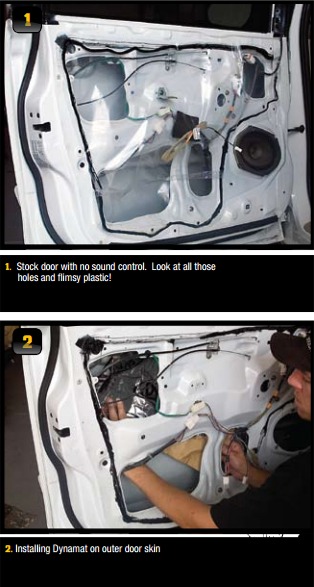 Stock speakers with stock electronics have enough power to vibrate your car doors, creating buzzes and rattles. Better quality speakers and aftermarket amplifiers have more output capability, causing even more vibrations and rattles. But the untold story about speakers mounted in doors is lost performance. The untreated thin sheet metal on stock doors is flimsy. When the speaker moves, the vibration of the metal is lost acoustical output from the speaker. Also, the outer door skin is extremely close to the back of the speaker. The reflection and reverberation created from the back-wave noise and distortion negatively affects the sound quality of the speaker. Don’t believe me? Take some aluminum foil, put it close to your mouth and speak. Hear the difference? Not only do you hear the vibration of the foil, you hear the sound of your voice change. Not good. And don’t forget the access holes. With so many holes on the inner door skin, you can’t expect any real mid-bass response. Stock speakers with stock electronics have enough power to vibrate your car doors, creating buzzes and rattles. Better quality speakers and aftermarket amplifiers have more output capability, causing even more vibrations and rattles. But the untold story about speakers mounted in doors is lost performance. The untreated thin sheet metal on stock doors is flimsy. When the speaker moves, the vibration of the metal is lost acoustical output from the speaker. Also, the outer door skin is extremely close to the back of the speaker. The reflection and reverberation created from the back-wave noise and distortion negatively affects the sound quality of the speaker. Don’t believe me? Take some aluminum foil, put it close to your mouth and speak. Hear the difference? Not only do you hear the vibration of the foil, you hear the sound of your voice change. Not good. And don’t forget the access holes. With so many holes on the inner door skin, you can’t expect any real mid-bass response.
Sound Control Solution In your car door, you are dealing with three types of noise: vibrational, airborne and reflective. The vibrational part is obvious. The midbass output from your door speakers causes buzzes and rattles of the door sheet metal and the door panel itself. Airborne noise comes from two sources. The outside road noise and the back-wave speaker output come through the holes in the inner door skin. The speaker’s back-wave noise is particularly bad because it not only colours the sound, but also cancels the bass output. The final problem is reflective: sound bouncing around where it shouldn’t. This happens in two locations. First, the back-wave sound from the speaker reflects (bounces) off the outer door skin. This sound interferes with the speaker and makes the speaker sound like it is playing through a tube. The second area is between the inner door skin and the decorative door panel. Sound bounces between them and gives it a reverb type of sound. The guys at Dynamat have developed a Good, Better, and Best solution to deal with these problems. |
Dynamat is the pro’s choice for turning Hot Rods into cool, quiet, and comfortable rides. Dynamat is the world’s leading product for eliminating unwanted noise, vibration, and heat. Dynamat offers a complete product line of performance automotive and restoration products including Dynamat Xtreme, Extremeliner, and Tac Mat. All of our products are engineered and scientifically tested in our “Real World” research and development lab. Take it from pro’s like Posie’s and Bobby Alloway . . . no project is complete without Dynamat – the ultimate automotive accessory. As seen on Overhaulin’ & Rides! Dynamat is sold in more than 5000 locations worldwide. For more information, visit www.dynamat.com.
Dynamic Control of North America, Inc.
Phone: (513) 860-5094
Fax: (513) 860-5095
Email: [email protected]
For additional support, email [email protected]
