Words: Tommy Parry
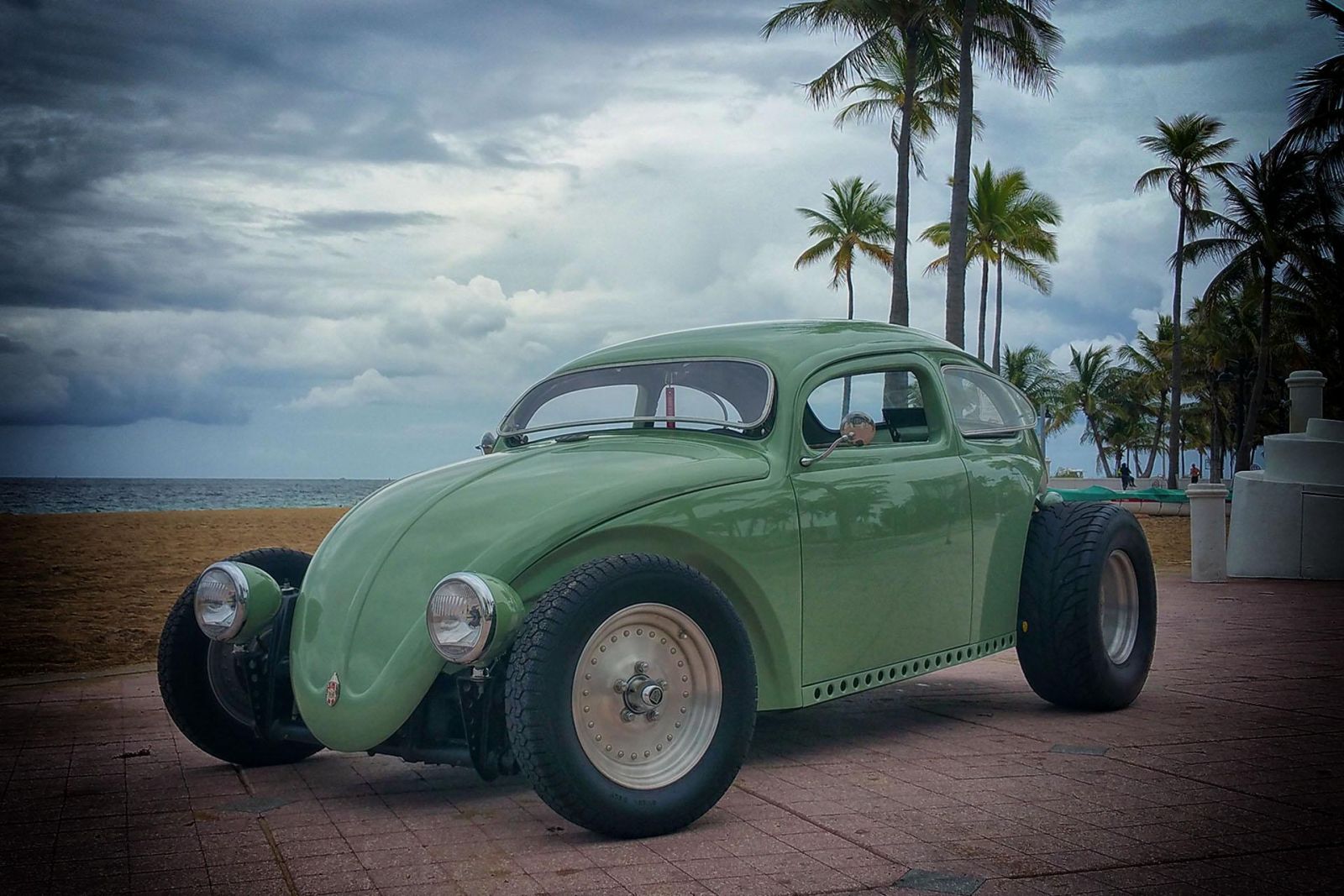
Eric had pondered the idea of building a Volksrod for quite some time. Eventually, he couldn’t restrain himself any longer and picked out a pretty ‘72 with fiberglass fenders and running board all around, but it had seen better days. Riddled with rust, the body needed all sorts of restoration, but thankfully, the 1641cc motor – fitted with twin Kadron carburetors – provided enough punch to get Eric motivated for a lengthy build ahead of him.
Wisely, Eric went for a new body entirely: a 1962 shell that is in very good shape, never been hit, perfect uncut dash and a smoothed rear deck, one piece windows with extra regulators and glass, a shell that would make any purist giggle with delight. Considering he dropped just $140 on the new shell and only needed to patch a minor section on the driver’s side heater channel, he had plenty of reason to grin.
He held onto the red shell for comparative purposes, since he would commit to chopping his ‘62 without much reference. The order of operations went as follows: A 4″ chop in the front, 2-1/2″ in the rear, the roof moved forward 2″, the B-pillar cut and realigned with body, and cut the rear inner fenders to align with body sides. When the haircut was complete and he could sit the two Volkswagens next to each other, the difference was startling.
After stripping the chopped Bug down, he took a look at his handiwork, sighed a sigh of relief and took the rusted body off his red donor Beetle – which he’d lovingly nicknamed “The Onion.” He then replaced The Onion’s floor pans, did some fab work to the tunnel, sat the new body on and replaced the parts of the heater channels which were corroded; first attaching what was functional to the pans before cutting, welding, and sanding – and not always in the safest way possible.
Then, with the aid of his metalworking genius of a friend, he had an additional 10.5” added with a beam extender. This goodie dropped the front end 2”. With the headlights mounted on custom, perforated brackets, a nifty tank and a custom VW badge sitting inside, it looked appropriately mean.
Turning their attentions to the inside of the machine, they created a custom dash inspired by a schoolbus, and with a custom steering column topped by a custom billet banjo wheel with a half wrap leather grip, there’d be spartan surroundings for the occupants.
While Eric was out on a business trip in California, he stopped by ProCar and asked them to custom make some seats for him. These simplistic beauties are exactly like their low-back series seats, but he had them shorten the bottom cushion area by 2″ so that they sit lower in the car; the chopped roof limits the cabin space. With these in place, Eric could go ahead and finish the steering column as well as the front end.
At another car convention, Eric picked up a set of coilovers and and quad-exhaust. Once he had them home, he disassembled the previous Stinger exhaust and added something that would provide the neighbors a little weekend misery. Not that the Beetle was short on style at this point, but custom taillight mounts and a perforated license plate frame would appease the most jaded of hot rodders.
After attaching new axles at all four corners, stainless steel brake lines and a drilled disc kit, Eric had the braking performance he was searching for. Being the busybody he is, he took the opportunity to remove the body from the frame and spray down any missed crud. You just can’t keep some people down.
With all the greasy bits attended to, it was time to start slathering on the bondo. At this point, the seemingly endless list of bodywork hiccups had been dealt with, and the build was done, aside from retrimming the window frames and sanding things down until it looked right – which, considering Eric’s standards, took some time.
Of course, a few popouts were in order. However, making the windshield do the same might take some people by surprise.
Though he’d hinted at the color throughout the build process, Eric kept the final decision quiet until he started spraying: A lovely mint-grey, called Verde Viaro, which is a play on the old VW Mango Green. The first coat went on well, and looking as good as it did, Eric kicked himself when he decided to try and improve upon it, since that process got ugly really quickly.
While shooting the clear coat, he used a medium reducer like he was supposed to, but since he lives in South Florida and is roughly twenty miles away from the surface of the sun, the clear was drying as fast as it was coming out. So, after shooting two coats of clear, he let it dry and came back to wet sand it, which helped it look near-perfect.
He then proceeded do some touch-up on some areas and airbrushed the base color in those spots before he re-shot the clear with a slow reducer in it so it would flow better. As soon as the clear hit the car, every touched-up spot stuck out out awfully. So, he had to strip the clear off once more and re-shoot the base. Yeesh. After the third coat, the final product was quite easy on the eyes, and totally worth all the wrench throwing and profanity.
Now came the task of readying the motor for the road. Though it looked tasty from the lot, it turned out to be complete trash – smaller than advertised and with so much crankshaft end play that he had to scrap the block. So, with the same intensity he’d approached the rest of the build, Eric started putting together a new, single-port engine.
Since it was a single-port engine which uses 10mm head studs, and he was putting on dual-port heads that use 8mm studs, he had to mill down the two center studs to clear the carb risers. Next, he tacked on 87mm jugs to make this motor a full 1641 cc, then lashed the valves, dropped the rockers and adjustable pushrod tubes in and replaced the electronic fuel pump with a mechanical unit.
And with a few additions to the interior, Eric had his chopped Beetle, dressed in mint green and ready to dazzle spectators across the country.
