Rust Removal Test, Part 1
By Wayne Scraba
Photos by Wayne Scraba
No matter where you live, when you work on old cars you’ll always run into in the inevitable: Corrosion. In some cases, it’s worse than in others, but even vehicles from the sunny south can have more than their fair share of rust. Some of it might be surface rust while some of it might that deep-rooted, heavy stuff that pits the metal. For our test, we chose the latter: Heavily rusted parts – pieces that were bolted on to a barn find car that hadn’t seen the light of day (or any good storage) for roughly 40 years. Basically it was a real test for two different forms of rust removal.
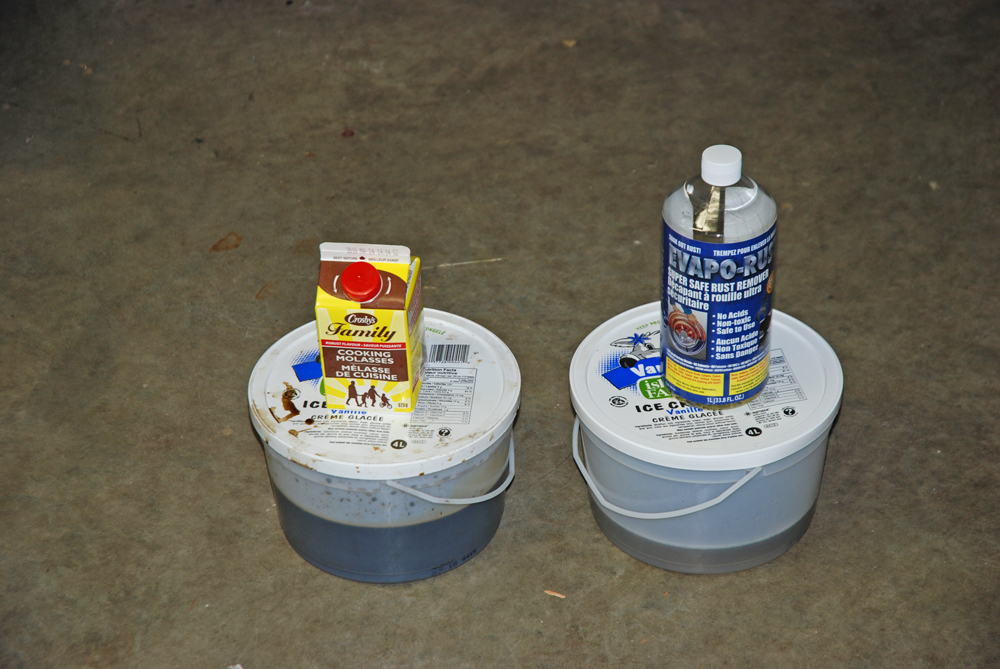
For this test we decided to use two common environmentally friendly methods of rust removal. The ground rules were simple: The products had to be easy to obtain. They had to be non-hazardous and they had to be biodegradable – basically, no Haz-Mat team required to touch or dispose of the stuff. Additionally, we didn’t want to use anything that we couldn’t use in the confines of our own garage. Essentially we didn’t want to expose ourselves or our best friend Joey the Shop Dog to any ugly odors or any harmful VOC’s that came from the rust removal process. We chose several parts that really couldn’t be disassembled (for example, motor mounts). This meant they included steel and rubber. The rubber could not be harmed in the process. Finally, we wanted to use simple plastic ice cream pails for the test. No parts washers. No special containers. Nothing except the basics.
First things first: We went right to the commercial rust removal product from Evapo-Rust.
Evapo-Rust is an environmentally safe, water-based rust remover that has been proven to make rust disappear in short order, without scrubbing. It’s easy to use. You simply toss the component in question into a bucket filled with Evapo-Rust, close the lid and walk away. In some cases, the rust can be removed in as little as a few hours, but for larger jobs, it’s pretty much necessary to let it sit overnight (in fact, we allowed some of our parts to sit for 24 hours).
Evapo-Rust is safe to use and is biodegradable. It’s non-toxic, non-corrosive, non-flammable, and contains no acids, alkalis, or petroleum solvents. That’s good news, and it obviously fit our criteria. Once a component is soaked in Evapo-Rust, it should be rinsed, and then re-dipped in the Evapo-Rust solution for a second or two. This will prevent flash rust. Evapo-Rust will not harm unrusted steel and it won’t harm brass, aluminum, galvenized metal, copper, rubber, plastic, vinyl or Viton (for example, the needle and seat assemblies used in many carburetors). In fact, most painted surfaces remain painted after immerision in Evapo-Rust.
So how does it work? Check out the accompanying photos:
We decided to use a rusty motor mount for the first test. Since the mount was built with rubber bonded to steel, it seemed like the perfect candidate for Evapo-Rust. As you can see, it had a lot of surface corrosion.
We poured a quart of Evapo-Rust into a plastic ice cream pail. For this test, we checked the progress after several hours. We decided to leave it in the solution for 24 hours.
Here’s the result of the process. As you can see, the heavy corrosion is gone. And what remains has either been turned black or has some minor flash rust.
In addition, we also soaked a set of crusty exhaust manifold bolts, washers and French locks in the solution. We don’t a “before” but this is the 24-hour result.
Another item we tossed into the pail was this transmission mount. This is the mount after removal from the Evapo-Rust. As you can see, the solution does no harm to the rubber.

VIP Sponsors
Sponsors