Rear Coil Springs
COIL SPRING SUSPENSION On a coil spring suspension, the spring is mounted between the axle housing and frame. A lower control arm connects the axle housing to the frame. Some vehicles use an upper control arm for added stability.
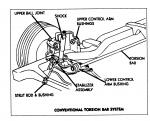
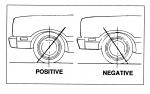
TORSION BAR SUSPENSION What: There are no coil springs in a torsion bar suspension system. Instead, a torsion bar supports the vehicle weight and absorbs the road shocks. While a coil spring performs these functions by compressing, the torsion bar acts by twisting. How: The torsion bar is connected between the lower control arm and the frame.… Continue reading Torsion Bars
LEAF SPRING SUSPENSION Control arms are not required on leaf spring suspensions. The leaf spring is connected to the axle housing with U-bolts and to the frame by bolts in the front and by a shackle assembly in the rear. The shackle assembly allows spring movement. In both applications, shock absorbers connect between the axle… Continue reading Leaf Springs
REAR SUSPENSIONS Rear suspension systems are as critical to ride control, as front-end systems. A vehicle must be in optimum pitch and balance to ride right. There are two types of conventional rear suspension systems: coil spring and leaf spring. COIL SPRING SUSPENSION On a coil spring suspension, the spring is mounted between the axle… Continue reading Rear Suspension
COIL SPRING SUSPENSIONOn a coil spring suspension, the spring is mounted between the axle housing and frame. A lower control arm connects the axle housing to the frame. Some vehicles use an upper control arm for added stability.
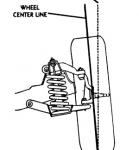
WHEEL ALIGNMENT What: An important part of vehicle ride control is directional control. Will the vehicle travel straight down a highway? Will it steer easily? Will the tires be subject to minimum wear? Will the steering wheel return to the straight-ahead position after turning a corner? For the answer to be YES to all these… Continue reading Wheel Alignment
LEAF SPRING SUSPENSIONControl arms are not required on leaf spring suspensions. The leaf spring is connected to the axle housing with U-bolts and to the frame by bolts in the front and by a shackle assembly in the rear. The shackle assembly allows spring movement. In both applications, shock absorbers connect between the axle housing… Continue reading Leaf Spring Suspension
CASTER What: Caster is the backward or forward tilt of the wheel spindle support. On a conventional suspension system, the upper and lower ball joints form the wheel spindle support. A line drawn through the centers of the two ball joints, as seen from the side of the vehicle, illustrates the tilt of the wheel… Continue reading Caster
CAMBER What: Camber is the inward or outward tilt of the wheels, as seen from the front. Camber is positive when the top of the wheel tilts outward and negative when the top of the wheel tilts inward. Camber is zero when the wheel is perfectly vertical. How: The camber angle is measured between the centerline of… Continue reading Camber
TOE What: Toe is the difference in the distance between the front of the front wheels and the distance between the rear of the front wheels. If the fronts of the wheels are closer together than the rear of the wheels, the difference in the distance is called “toe-in.” If the fronts of the wheels… Continue reading Toe
VIP Sponsors
Sponsors